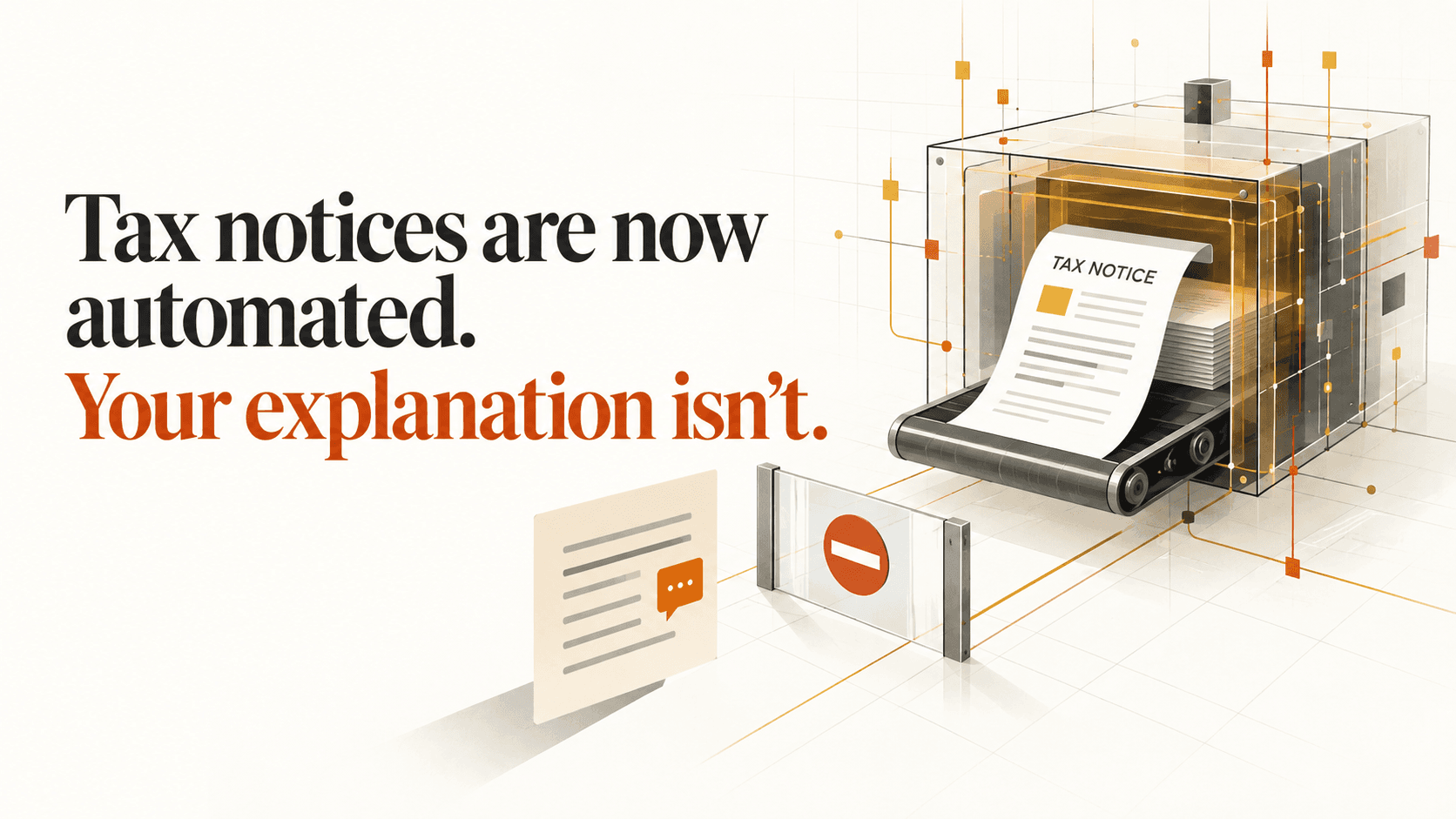
The CBDT has collected ₹16,083 crore through targeted communications — with no notice, no assessment order and no right of appeal. Case selection is automated, but the officer's screen has no field for the taxpayer's explanation, so approval becomes the path of least resistance. What that asymmetry costs, who pays for it, and four changes that would close the gap.
Archit Agarwal
Thinkbiz Professional
Share a few details and we'll open the full document — read it here or download a copy to keep.
Free · No spam · Takes 10 seconds
About the author
Archit Agarwal
Thinkbiz Professional
Member of the multi-disciplinary team at Thinkbiz Professional LLP, Noida.
Need expert advice on this topic?
Book a free 30-min call with one of our partners.
Summary
With a single NUDGE campaign, the Income Tax Department reported 1.25 crore updated returns and ₹9,494 crore in additional tax.
No notice. No assessment order. No reasons recorded. No appeal.
On the indirect tax side, GSTN now handles around 3 billion API calls a month, and CBIC runs ADVAIT and BIFA — big data, machine learning, network analysis — to build risk profiles. Under rule 88D, an ITC mismatch above ₹1 lakh or 20% generates a DRC-01C intimation on its own. The taxpayer gets 7 days to pay or explain.
The technology is impressive. The counter-argument underneath it is being quietly ignored.
1. The system shows the officer a variance. It has no field for the assessee's explanation. Approving costs him nothing. Declining requires him to record a justification for overriding the system. Approval becomes the path of least resistance.
2. Raising a flag costs the department close to nothing. Answering it costs a business reconciliation, professional fees, a 10% pre-deposit at first appeal, and eighteen months of senior attention.
3. Assume 95% accuracy across 1 million flagged files. That is 50,000 wrong proceedings. A machine that is right 95% of the time is impressive. At scale it is also a large transfer of cost onto people who did nothing wrong.
4. And the asymmetry is complete. The benefit of additional collection sits with the exchequer. The cost of the error sits with the assessee. Win, and nothing is recovered. Nothing attaches to the officer who declined a genuine claim either.
None of this is an argument against automation. It is an argument for building the other half of it.
#IncomeTax #GST #TaxCompliance #CharteredAccountants